Here is a mistake that survives peer review more often than it should. A team runs an experiment once, measures it in triplicate wells, sees tight error bars, and reports a significant effect. The error bars are tight because the three wells came from the same run, the same batch, the same day. They describe how precisely one experiment was measured, not whether the experiment would happen again. The difference between biological replicates and technical replicates is the difference between a result you can trust and a result that just looks trustworthy, and it is worth getting right before you design a single plate.
The two kinds of replicate answer two different questions
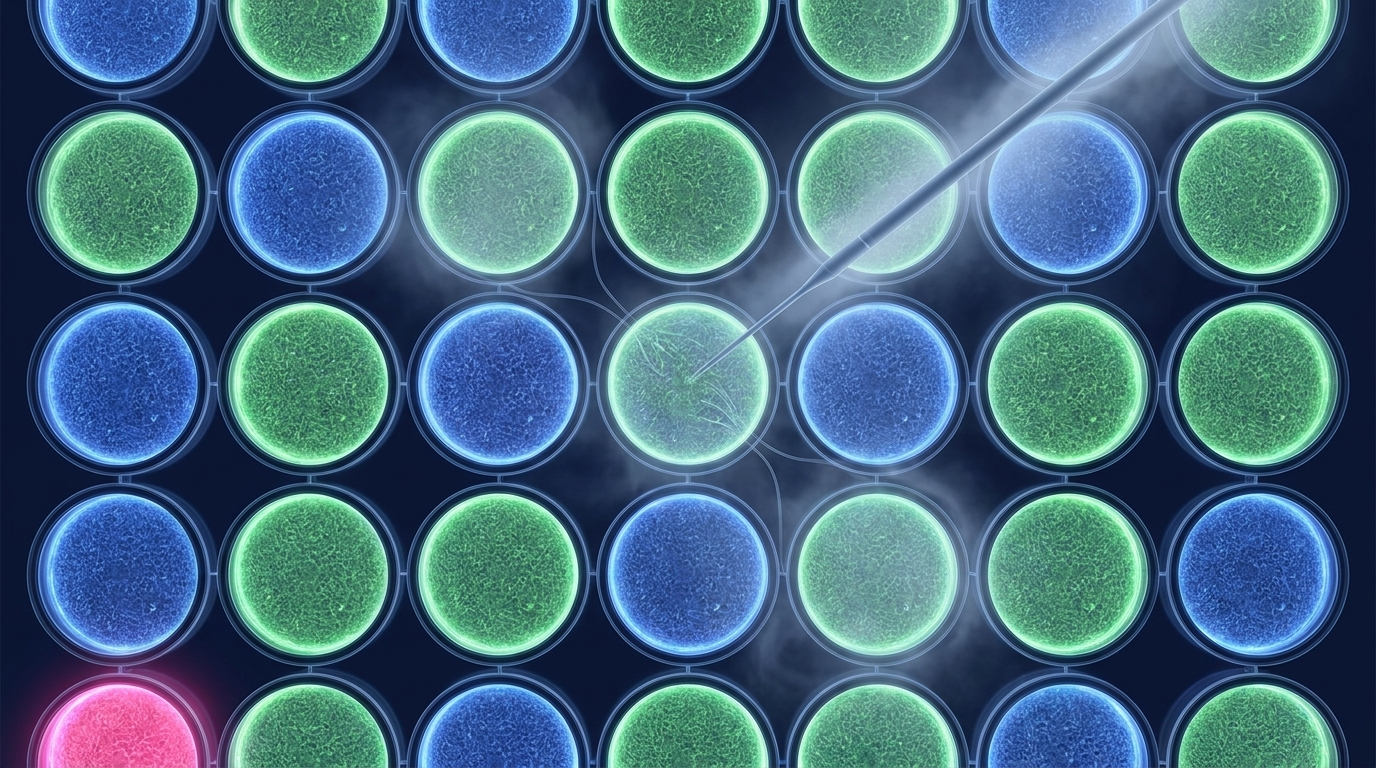
A technical replicate repeats the measurement. Three wells from the same batch, split on the same day, read on the same instrument, tell you how reproducible your pipetting and your reader are. That is real information, but it is narrow. It quantifies measurement precision and nothing more.
A biological replicate repeats the biology. A different donor, a different lot, an independent run on a different day, tells you whether the effect holds across the variation that actually matters. That is the question a drug program is really asking. Not “how precisely did I measure this one monolayer,” but “will this happen again in a different set of cells.”
Confuse the two and you get overconfidence with a statistical veneer. Three technical replicates can produce a beautiful p-value that means almost nothing, because averaging repeated measurements of a single biological sample shrinks the error bar without adding any evidence that the result generalizes. Statisticians call the underlying error pseudoreplication: treating measurements that are not independent as if they were. A 2014 primer in Nature Methods on statistical replication makes the point plainly, that the number that belongs in your statistics is the number of independent biological units, not the number of times you pipetted each one.

Why this bites hardest in a primary cell model
The stakes are higher in a human primary cell system than in a cancer line, and for a good reason. The whole value of primary cells is that they carry biological variability, the donor-to-donor range that a single-genotype line erases. That variability is the signal. But it means a result from one donor, however precisely measured, does not tell you what happens across donors. You have to actually sample the biology to make a claim about it.
So the design implication is direct. If you run one donor in technical triplicate and report significance, you have measured one person carefully and learned nothing about the population. If you run three donors, each in technical replicate, you have measured the effect across the biology and can say something that generalizes. The technical replicates still earn their place, because they clean up measurement noise within each biological unit. They just cannot substitute for the biological ones.
| You have | You can claim | You cannot claim |
|---|---|---|
| One donor, triplicate wells | This monolayer showed the effect, measured precisely | The effect generalizes |
| Three donors, single wells | The effect appears across donors | It is free of measurement noise |
| Three donors, triplicate wells | The effect holds across biology, cleanly measured | Much more, and you rarely need to |
Designing the experiment backward from the claim
The fix is to decide what you want to claim first, then build the replicate structure to support it. If the claim is about a compound’s effect in humans, the independent unit is the donor or the lot, and that is the number your statistics are powered on. Technical replicates sit underneath, tightening each measurement. Pooling can still make sense when a representative estimate is the goal, but it is a choice to be made deliberately, the same deliberate choice that runs through how to handle donor variability.
This is also where reproducibility and statistics meet. Biological replicates are only meaningful if each one is a clean, well-controlled run, which puts you right back on well-to-well consistency and lot release. A biological replicate built on a leaky monolayer or an unqualified batch is not independent evidence. It is noise wearing a lab coat. The pieces reinforce each other, which is the whole point of treating reproducibility in a primary-cell model as one connected discipline rather than a checklist.
The practical rule
A model gives you the ability to sample real human biology across donors and lots. A sound replicate design is what turns that ability into a claim you can defend. Run enough biological replicates to speak to the population, use technical replicates to sharpen each one, and never let the second stand in for the first.
That discipline is what makes the human relevance of a system like RepliGut® usable in practice, whether the readout is permeability and metabolism or barrier and inflammation biology. The model supplies the biology. The replicate design decides whether your conclusion survives contact with the next experiment.
Tight error bars are easy. Reproducible ones are the point.