Ask a program lead which toxicity they are most afraid of finding late, and the gut is rarely the first answer. It should be closer to the top. Gastrointestinal toxicities are the most frequently encountered clinical adverse events across drugs in development, and when they show up they do not just bother patients, they cap the dose. A drug that works but cannot be tolerated at an effective dose is a program in trouble, and preclinical GI toxicity screening is where you would want to catch that, long before the clinic makes the point for you.
Most of the time we do not catch it. The tools the field reaches for were not built to see intestinal injury the way a human experiences it, and the result is a blind spot that keeps costing programs dose, time, and sometimes the whole asset.
The problem is common, expensive, and concentrated where the stakes are highest
Start with how often this happens. Across pharmaceuticals in development, GI adverse events are the single most common category of clinical adverse event, a point made repeatedly in the toxicology literature. This is not a rare, specialized failure mode. It is simply the most likely form of adverse event.
It concentrates in the areas under the most commercial pressure. Oncology carries the lowest odds of regulatory approval of any therapeutic area, and GI toxicity is a leading dose-limiting factor in cancer treatment: more than a third of patients on many chemotherapeutic regimens experience grade 3 or 4 diarrhea. The newer modalities are not exempt. Antibody-drug conjugates report nausea and diarrhea as prominent, sometimes dose-defining, adverse events. Oral incretins for obesity and diabetes lose patients to nausea and diarrhea during dose escalation, which is one reason the entire class titrates slowly. Different molecules, same organ, same story: the gut decides how much drug a patient can actually take.
Why the standard tools miss it
If GI toxicity is this common, why is it so often a clinical surprise? Because the two models most teams rely on were not designed to report it.
Animal studies are living tissue, but they are the wrong tissue. Species differ enough in intestinal physiology, transit, and epithelial turnover that GI findings translate poorly, and the broader failure rate makes the point: the FDA has noted that more than 90 percent of drugs that look safe in animals still fail in humans. When the question is specifically about human gut tolerability, an animal result is a weak proxy.
Caco-2, the immortalized colorectal cancer line that anchors most in vitro intestinal work, has a different problem. It was selected to form a tight monolayer for permeability, not to behave like renewing human epithelium. It carries the rewired signaling of a cancer line, and, more to the point for toxicity, it has no meaningful proliferative compartment. The healthy intestine is one of the fastest-renewing tissues in the body, and many drugs injure it precisely by hitting the dividing stem and progenitor cells in the crypt. A model with no crypt biology cannot show you that injury. It can tell you a barrier came apart, eventually, but not that renewal stopped, which is often where the damage actually begins.
And the most common readout, a single viability number, tells you the least. It confirms that something died. It does not tell you what died, where in the tissue, or why, and those are the answers that let a chemist do something about it.
What a human stem cell model actually reads
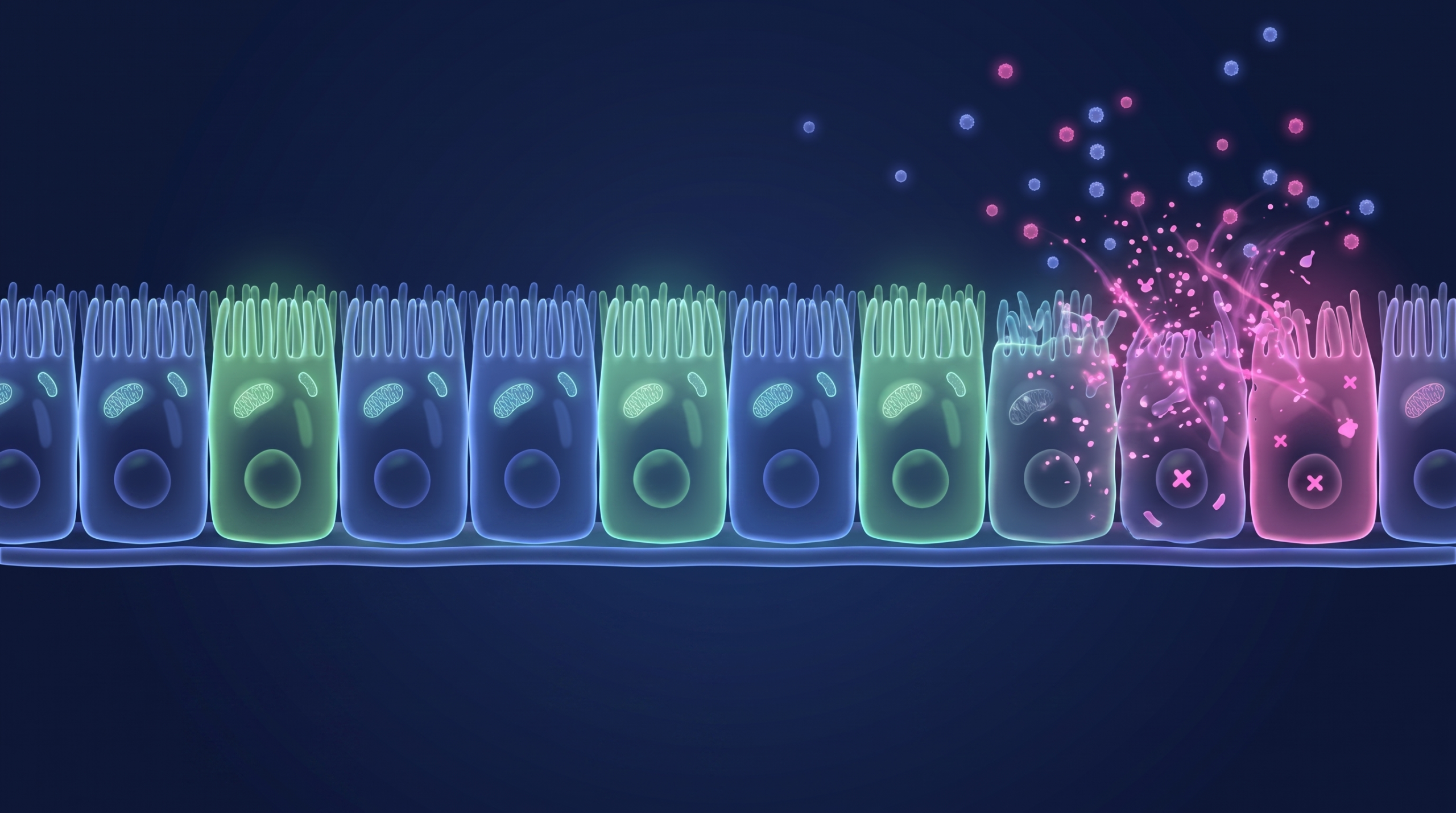
This is the biology RepliGut® is built to reproduce. It grows a differentiated intestinal epithelium from primary human intestinal stem cells, so the tissue proliferates, matures, and forms a barrier the way the human gut does. That structure is what lets you read injury with some resolution instead of a single pass/fail.
Because the model has a real proliferative phase and a differentiated phase, you can ask where a drug lands. Does it stop the crypt from renewing, or does it damage the mature barrier, or both? Our own published validation put numbers on this. In a study of 30 marketed drugs across three human donors, a RepliGut® Planar assay predicted clinical diarrhea risk with balanced accuracy of 91 percent from proliferative cell abundance, 90 percent from total cell abundance, and 88 percent from barrier integrity, and it did so at drug concentrations tied to clinical exposure. Benchmarked head to head, the primary-cell model outperformed a Caco-2 assay on the same task. That is the difference between a model that reads human crypt biology and one that never had it.
The point is not that any single number is magic. It is that reading proliferation, cell number, and barrier together tells you what kind of injury you are looking at, early enough to act on it.
| What you want to know | Animal study | Caco-2 monolayer | Human stem-cell epithelium |
|---|---|---|---|
| Human-specific gut tolerability | Weak, species-limited | Cancer-line, not human tissue | Yes, primary human epithelium |
| Damage to the renewing crypt | Not resolved | No proliferative compartment | Proliferative readout |
| Barrier vs renewal, told apart | No | Barrier only | Both, on the same tissue |
| Concentration tied to clinical exposure | Indirect | Limited | Yes, referenced to Cmax |
Why this matters now
The timing is not incidental. Regulators are actively opening the door to human-relevant methods. The FDA Modernization Act 2.0 removed the blanket requirement that drugs be tested in animals, and the agency’s April 2025 roadmap set a direction toward reducing animal testing in preclinical safety work in favor of new approach methodologies. That does not ban animal studies, and it does not hand any single model a stamp of approval. What it does is raise the ceiling on how far a well-validated human in vitro assay can carry a safety argument. As that ceiling rises, the gap between a model that reads human GI biology and one that approximates it stops being academic.
I have spent enough time around preclinical decisions to know that GI toxicity rarely gets the attention its frequency deserves, usually because the tools made it easy to defer. That is the part worth changing. The injury is common, it is dose-limiting, and it is readable earlier than most programs assume, if the model is built on the right tissue.
If GI tolerability is a live question for your program, the honest first step is to see the injury before the clinic does. Explore how the StemTox GI toxicity assay reads intestinal injury on a human epithelium, and the RepliGut platform it runs on. The rest of this cluster goes deeper on the pieces: predicting drug-induced diarrhea before the clinic, the GI toxicity of ADCs and oncology drugs, and why a single barrier number is not enough to call a drug safe on the gut.