
Drug Transporter Assay on Human Gut Tissue.
Measure active efflux and uptake on RepliGut® Planar, a human intestinal epithelium grown from donor stem cells. Confirm P-gp and BCRP function, add inhibitors, and pin the transporter that moves your compound.
Design your studyExplore RepliGut® PlanarWhy transporters make or break exposure
A drug transporter assay shows whether efflux and uptake carriers control how much of a compound is absorbed. Carriers like P-gp and BCRP can pump a drug back into the gut lumen, capping bioavailability and driving interactions.
Caco-2 carries an altered, colon-tumor transporter profile. Expression shifts with passage and culture, so efflux reads can drift from human biology. Regulators expect a clear transporter assessment, set out in the FDA guidance on in vitro drug interaction studies.
Functional transporters on human tissue
RepliGut® Planar grows from human donor stem cells and expresses the transporters that govern oral absorption. You measure real carrier function, then choose the gut region where it matters. That fits the move toward human-relevant alternative testing methods.
| Feature | Caco-2 | RepliGut® Planar |
|---|---|---|
| Transporter expression | Altered and passage-dependent, from a colon tumor. | Human transporters, P-gp and BCRP enriched over Caco-2. |
| Efflux function | Variable, harder to reproduce. | Active efflux, ratio above 2, confirmed with inhibitors. |
| Regional profile | One fixed colon-tumor profile. | Duodenum, jejunum, ileum, or colon, chosen to fit the carrier. |
| Uptake carriers | Limited representation. | PEPT1, OATP, OCT, MCT, ASBT, and OST expressed. |
P-gp runs low in the jejunum and rises through the ileum and colon. A single Caco-2 profile cannot capture that gradient. RepliGut® lets you test transport in the region where the carrier actually acts, so the efflux read reflects real intestinal biology.
What the drug transporter assay delivers
The assay runs in a 96-well transwell with apical and basal access. We dose one side, sample the other, and quantify by accurate mass LC/MS to resolve active transport.
Efflux ratio
Bidirectional transport gives efflux ratios above 2 for P-gp and BCRP substrates, measured by LC/MS.
Substrate confirmation
Digoxin for P-gp and estrone-3-sulfate for BCRP anchor the assay as positive controls.
Inhibitor studies
Add tariquidar for P-gp or Ko143 for BCRP to pin transport to a specific carrier.
Region and donor options
Profile transport across duodenum, jejunum, ileum, and colon, and across multiple donors.
Active efflux you can measure and block
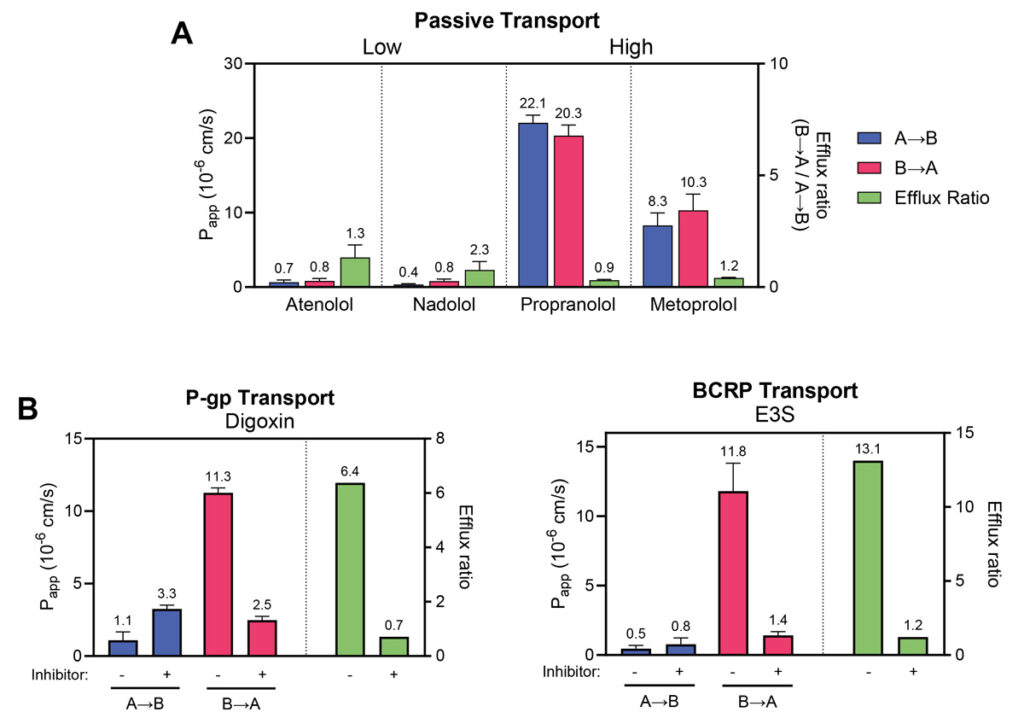
Digoxin and estrone-3-sulfate show clear efflux on RepliGut® Planar Jejunum. Basal to apical transport runs higher than apical to basal, giving efflux ratios above 2.
Adding tariquidar or Ko143 collapses those ratios. That confirms functional P-gp and BCRP, and it isolates each carrier. See the method in our publications.
Efflux and uptake, mapped to the membrane
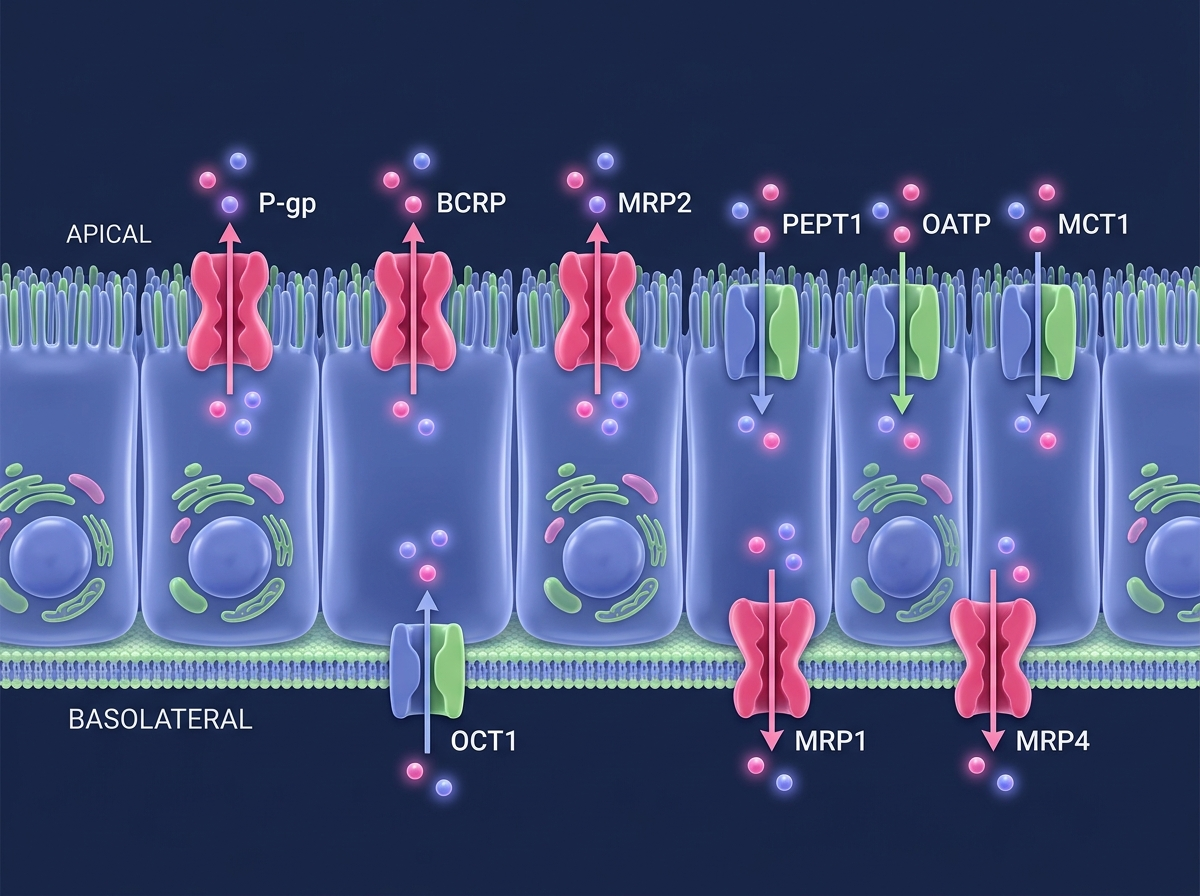
RepliGut® Planar carries the carriers that shape oral absorption. Apical efflux runs through P-gp, BCRP, and MRP2. Apical uptake uses PEPT1, OATP, and MCT1. Basal membranes add OCT1 and the MRP family.
Map expression by region, then design transport studies around the carriers that matter for your compound. Passive uptake belongs on our permeability assay page.
Built to reflect the human gut
Human transporters
P-gp and BCRP are enriched over Caco-2, in an epithelium grown from human donor stem cells.
Functional and inhibitable
Efflux ratios above 2, reduced by tariquidar and Ko143, confirm active, specific transport.
Regional range
Study transport where a carrier acts, from duodenum through jejunum, ileum, and colon.
Apical and basal access
The planar transwell format opens both surfaces for true bidirectional transport studies.
Run it in your lab or have us run it
RepliGut® Kits
Run transport studies in your own lab. Kits ship in 12-well and 96-well formats, complete with cells, plates, media, and technical support.
Explore kitsFull-service transporter studies
Have our scientists run it. We deliver efflux ratios, inhibitor data, and regional transporter profiles, ready for your model.
Explore servicesPart of a broader program? Explore the full RepliGut® platform or our in vitro DMPK and ADME capabilities.
Ready to run a transporter assay on human tissue?
Send us your compound. We will design a drug transporter assay on RepliGut® Planar and confirm the carriers that control its fate.
Design your study