
A Human Epithelial Regeneration Assay.
RepliGut® Crypt is the first primary stem cell platform that recreates gut cell turnover, so you can measure epithelial damage, repair, and renewal on human tissue.
The self-renewing human gut, recreated in vitro
The lining of the human gut renews itself faster than almost any tissue in the body, completely replaced about every three to five days. Stem cells in the crypt proliferate, differentiate, and migrate outward without pause to keep the barrier intact. RepliGut® Crypt is an epithelial regeneration assay that captures that full turnover cycle, built from primary human intestinal stem cells.
It is the first stem cell platform to recreate proliferation, differentiation, and migration in one controllable in vitro system. That lets you damage the epithelium, then watch it repair and renew, the way real human tissue does.
Cells self-organize on an engineered scaffold into a stem cell niche surrounded by proliferative, differentiating, and mature cells. When you injure that tissue with a chemical or inflammatory challenge, you can measure how a compound helps or hinders repair. No animal model offers this readout with human cells.
Gut cell turnover, recreated in vitro
In the human gut, stem cells at the crypt base divide and their daughters migrate outward, differentiating as they go. RepliGut® Crypt recreates that turnover on an engineered scaffold. A growth factor signal rises through a microhole, holding cells above it in a proliferative state, while cells that migrate away differentiate into absorptive and secretory lineages.
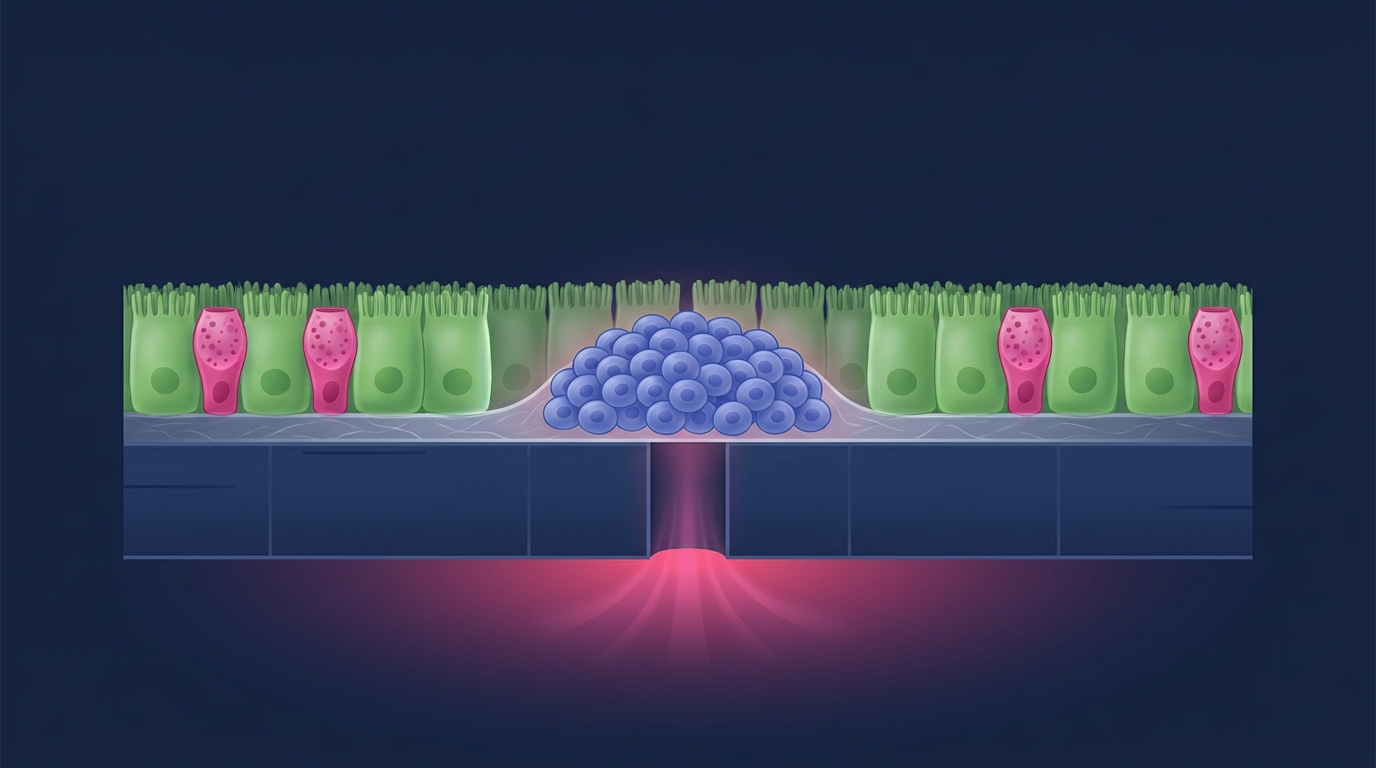
Growth factor rises through the microhole and keeps the cells above it proliferating. As their daughters move outward, they differentiate into the mature epithelium, green absorptive cells and pink secretory cells, in the continuous renewal of the gut epithelium.
Cell turnover, captured in the assay
This is not just a schematic. In a pulse chase experiment, proliferative cells labeled over the microhole migrate outward across the crypt unit over several days. The proliferative zone expands measurably, direct evidence of the turnover that makes this an epithelial regeneration assay.

Proliferative and mature cells, spatially segregated
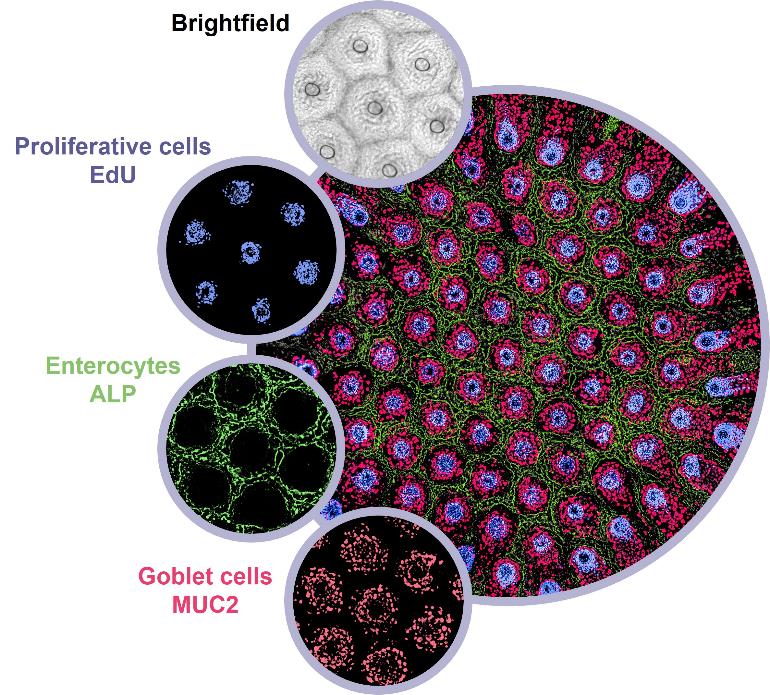
Cultured on an impermeable scaffold laser drilled with an array of microholes, primary human colonic stem cells self-organize into repeating crypt units. Cells over each microhole stay proliferative, marked by EdU. Cells around them differentiate into absorptive enterocytes, marked by ALP, and secretory goblet cells, marked by MUC2.
Brightfield shows the microhole array. Fluorescence resolves each population within every crypt unit.
Measure the repair response directly
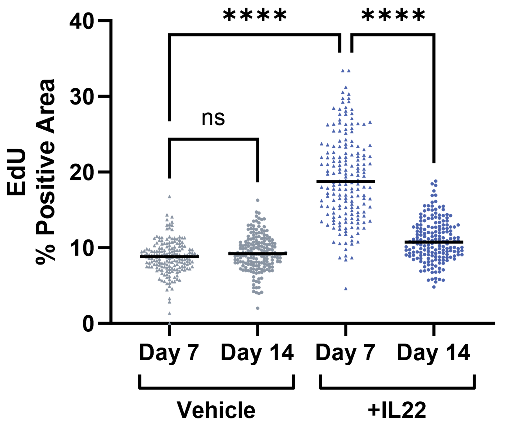
Because the tissue renews itself, you can quantify how a compound shifts the balance of cell types. In this study a seven day treatment with the cytokine IL-22, a natural driver of gut repair, significantly increased proliferative EdU positive cells and reduced mature ALP positive enterocytes. After a seven day washout both effects reversed, so the assay captures a dynamic, reversible repair response rather than a fixed endpoint.
That gives drug and safety teams a human readout for pro repair and anti proliferative effects that legacy models cannot provide.
See IBD damage and repair workWatch the tissue mature and hold
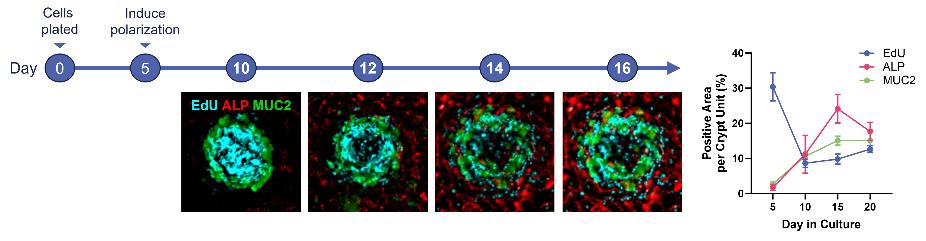
After plating, the epithelium polarizes and its cell populations shift into physiologic balance, then stay stable for the length of the assay. That longitudinal stability is what makes long repair and renewal studies possible.
One epithelial regeneration assay, many programs
The same self-renewing tissue supports damage, repair, and safety questions across therapeutic areas. Pick the application your program needs.
Epithelial damage and repair
Injure the epithelium, then quantify how compounds drive or block renewal and regeneration.
Inflammatory disease modeling
Model inflamed gut biology and test therapeutics that protect or restore the barrier in IBD.
Stem cell proliferation
Measure pro and anti proliferative effects on the human intestinal stem cell pool directly.
Drug safety assessment
Flag compounds that damage the regenerative compartment before they reach the clinic.
Efficacy and lead optimization
Rank candidates by their effect on human epithelial repair and renewal.
High content readouts
Quantify EdU, ALP, and MUC2 per crypt unit with custom image analysis.
Why the model holds up
Human relevance
Primary human colonic stem cells mirror the architecture of the real gut, not an immortalized line.
Dynamic cell behavior
Proliferation, differentiation, and migration happen side by side, so you can study turnover as it occurs.
Renewal you can measure
Self renewal makes damage, repair, and regeneration quantifiable in a high throughput format.
Work with our team on your study
Full-service studies
Have our scientists design and run the epithelial regeneration assay on human tissue, then deliver quantified EdU, ALP, and MUC2 data ready for your model.
Explore servicesExplore the platform
RepliGut® Crypt is one model in the RepliGut® platform. See how the stem cell system also powers Planar and Immune Co-Culture.
Explore RepliGut® SystemsStudying barrier and absorption instead of turnover? See RepliGut® Planar. For rapid gut safety screening see StemTox, or browse the full applications hub. Human relevant models also match the FDA push toward New Approach Methodologies.
Measure epithelial repair on human tissue
Tell us your compound and your question. We will design the right RepliGut® Crypt epithelial regeneration assay for your program.
Design a study