
Drug-Drug Interaction Assay on Human Gut Tissue.
Measure nuclear receptor induction on RepliGut® Planar, a human intestinal epithelium grown from donor stem cells. Probe PXR, AhR, and VDR with prototypical inducers, and read gut-specific interaction risk.
Design your studyExplore RepliGut® PlanarWhy the gut has its own interaction risk
A drug-drug interaction assay flags whether a compound induces the enzymes and transporters that clear other drugs. In the intestine, that induction runs through nuclear receptors such as PXR, AhR, and VDR.
Caco-2 cannot model these pathways well, and the gut induction profile differs from the liver. So a liver-only view misses interactions that start in the intestine. Regulators expect a clear induction read, set out in the FDA guidance on in vitro drug interaction studies.
Induction the intestine actually shows
RepliGut® Planar expresses functional nuclear receptors, so you can activate each pathway with its classic inducer and read the response by gene expression. The gut profile is distinct from the liver. That supports the shift toward human-relevant alternative testing methods.
| Pathway | Inducer | What the intestine shows |
|---|---|---|
| PXR / RXR | Rifampin | Activation needs about 100 times the liver dose, so intestinal PXR-mediated interaction risk is lower than in the liver. |
| AhR | 3-Methylcholanthrene | Gene induction appears at concentrations as low as 100 nM. |
| VDR | Calcitriol | Induction at low doses, and vitamin D can reach high levels in the gut, so nutrient-drug interactions matter here. |
Vitamin D supplements can exceed 1200 uM in the small intestine, enough to drive VDR-mediated induction the liver never sees at those levels. RepliGut® is an ideal model for nutrient-drug interactions through nuclear receptor pathways, which Caco-2 and liver models miss.
What the drug-drug interaction assay delivers
The assay doses mature RepliGut® Planar with a chosen inducer, then profiles the induced genes. You get a gut-specific read on enzyme and transporter induction.
PXR induction, rifampin
Dose rifampin and measure CYP3A4 and related induction by gene expression, the classic PXR readout.
AhR induction, 3-MC
Activate the aryl hydrocarbon receptor with 3-methylcholanthrene and track CYP1A induction.
VDR induction, calcitriol
Probe vitamin D receptor signaling with calcitriol, central to nutrient-drug interactions.
Gene expression profiling
Quantify fold induction by RNAseq or qRT-PCR across enzymes and transporters, dose by dose.
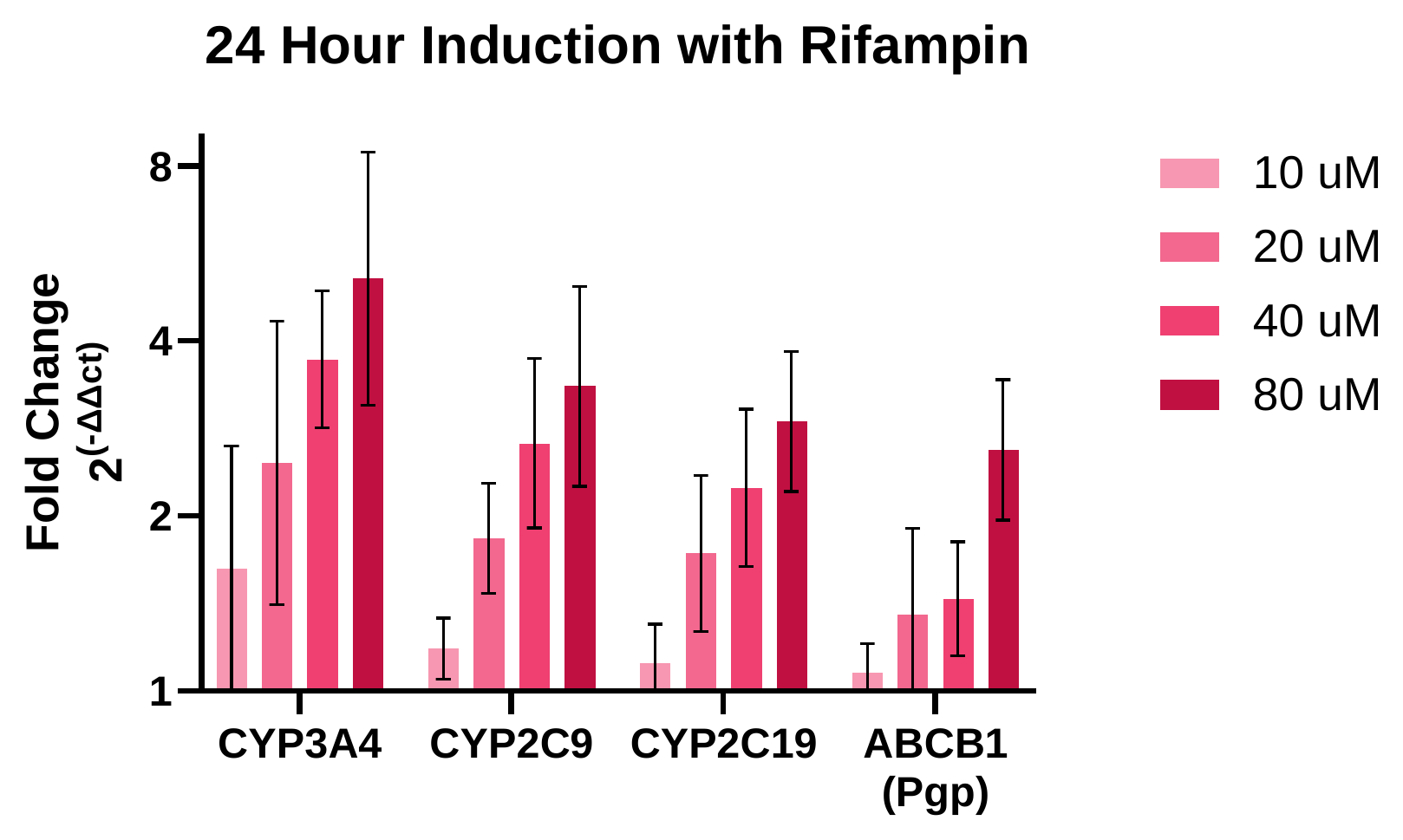
Dose-dependent induction with rifampin
RepliGut® Planar shows clear dose-dependent induction after 24 hours of rifampin. CYP3A4, CYP2C9, CYP2C19, and P-gp all rise with concentration.
That confirms functional PXR-mediated induction in human intestinal tissue, the signal a drug-drug interaction assessment depends on. See the method in our publications.
A model for nutrient-drug interactions
The gut meets dietary compounds at concentrations the liver never sees. Vitamin D, for one, can reach high levels in the small intestine and drive VDR induction. RepliGut® lets you test how nutrients and supplements interact with drug metabolism through nuclear receptor pathways, then follow up on our intestinal metabolism assay.
Built to reflect the human gut
Human nuclear receptors
PXR, AhR, and VDR are functional in an epithelium grown from human donor stem cells.
Gut-specific profile
Induction responses are distinct from the liver, so gut interaction risk gets its own read.
Dose-dependent signal
Rifampin drives clear, dose-dependent induction of CYP and transporter genes.
Region and donor range
Profile induction across gut regions and multiple donors to capture real variability.
Run it in your lab or have us run it
RepliGut® Kits
Run induction studies in your own lab. Kits ship in 12-well and 96-well formats, complete with cells, plates, media, and technical support.
Explore kitsFull-service DDI studies
Have our scientists run it. We deliver dose-response induction and gene expression profiles, ready for your model.
Explore servicesPart of a broader program? See our intestinal metabolism assay and drug transporter assay, or the full in vitro DMPK and ADME hub.
Ready to run a DDI assay on human tissue?
Send us your compound. We will design a drug-drug interaction assay on RepliGut® Planar and profile gut-specific induction risk.
Design your study