A model can be perfectly reproducible in the lab that built it and still fall apart the moment it lands somewhere else. This is the version of the reproducibility problem that bites hardest in practice, because it shows up after you have already decided to adopt the assay. The data looked clean in the vendor’s hands. Now it is in yours, the monolayers are not closing, the controls are drifting, and the confidence you had a month ago is gone. Assay transfer is where reproducibility is won or lost, and it deserves more attention than it usually gets.
Let me explain why the handoff is the dangerous part, and what actually protects it.
Most variability enters when the assay changes hands
The data on this is unusually clear. When the same compounds are run through Caco-2 across multiple laboratories, the disagreement between labs is far larger than the disagreement within any one of them. A study that sent five compounds to ten laboratories found interlaboratory ranges up to 44-fold, against within-lab swings up to 16-fold. The gap between those two numbers is the whole story. Moving an assay between labs introduced more variability than anything happening inside a single lab.
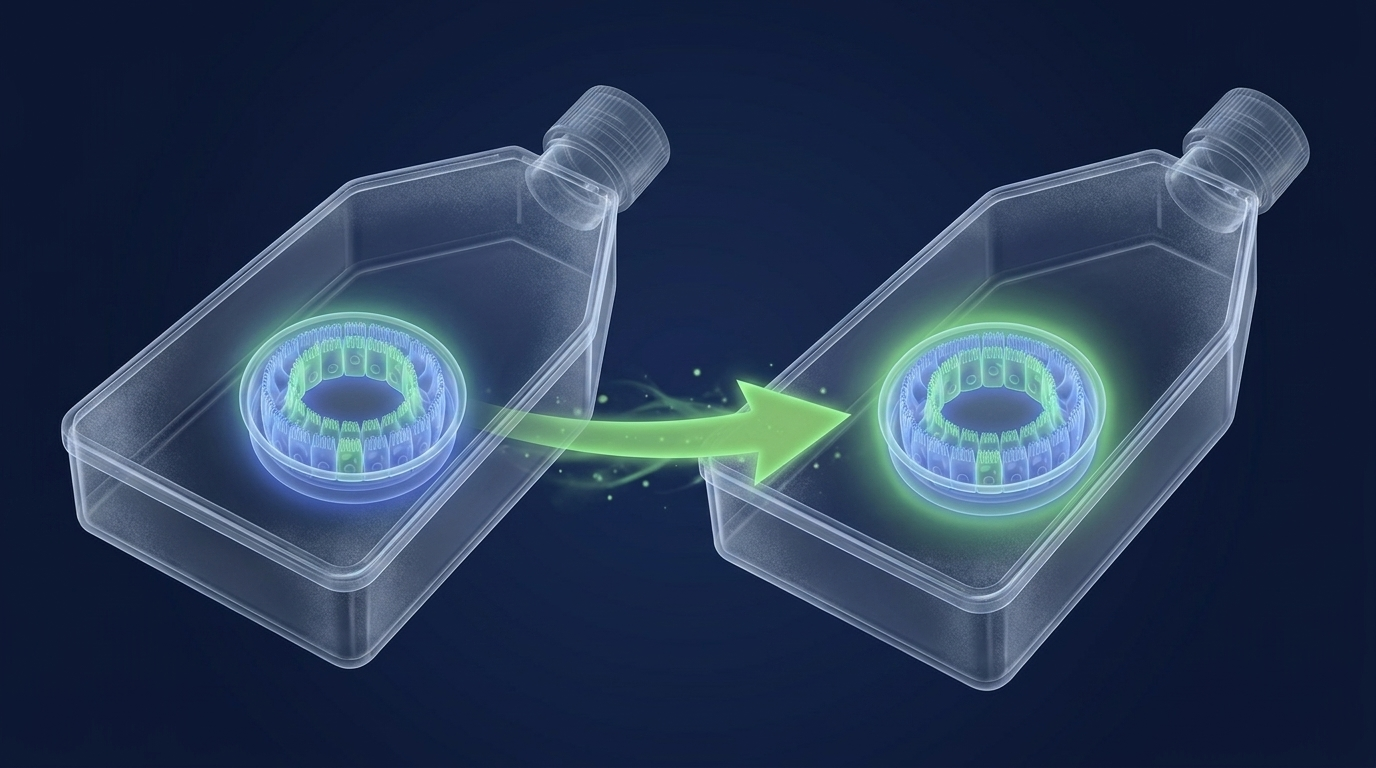
The biggest reproducibility risk you face with a new model is not the model on the vendor’s bench. It is the translation of that model onto yours, where different water, different incubators, different hands, and different undocumented habits all get a vote. An assay is not just a protocol. It is a protocol plus a hundred small things the originating lab does without writing down.
The tacit-knowledge problem
The reason assays drift on transfer is that a lot of what makes them work never makes it into the protocol. The exact way cells are resuspended. How long they sit before plating. The feel of a monolayer that is ready versus one that needs another day. This is tacit knowledge, and it lives in the hands of the people who run the assay every day. When the assay moves and the tacit knowledge stays behind, the written protocol alone is not enough to reproduce the result.
You cannot fix this by writing a longer protocol, because the whole point is that the missing steps are the ones nobody thought to write. You fix it two other ways. You reduce the number of steps that depend on tacit skill, and you standardize the ones that remain so that judgment is replaced by a defined criterion. A kit that ships qualified cells with a defined seeding density and a confluence gate is doing exactly that: it moves decisions out of the technician’s intuition and into the format, where they transfer.
What actually protects a transfer
A few things reliably shrink the interlab gap, and they are worth demanding of any model you plan to run in-house.
Qualified starting material, so the cells are the same on your bench as on the vendor’s and the variable you are removing is the biology, not the batch. A standardized format, so seeding, coating, and confluence are set by the kit rather than reinvented locally. Objective gates instead of judgment calls, so barrier integrity is a TEER threshold rather than a feel. And onboarding support, so the tacit knowledge is transferred deliberately by the people who have it rather than left to be rediscovered. That last one is not a nicety. It is the mechanism by which the unwritten steps actually move.
| What travels well | What gets lost in transfer |
|---|---|
| A defined seeding density | The knack for even resuspension |
| A TEER confluence gate | The feel of a monolayer that is ready |
| Qualified, release-tested cells | A local batch nobody characterized |
| A written, objective protocol | The unwritten steps that make it work |
Designing for the handoff
The takeaway is that reproducibility in your hands is a design goal, not an accident, and it starts with choosing a model built to be transferred rather than one that only performs where it was born. That is a principle behind RepliGut®: qualified cells, a standardized kit format, objective barrier-integrity gates, and onboarding meant to carry the tacit steps across, so the assay behaves the same on your bench as on ours.
The handoff is the run-level counterpart to the batch-level discipline of lot release and the daily discipline of well-to-well consistency, and it is part of the same larger question of whether a primary-cell gut model can be trusted. It matters most for teams standing up permeability and metabolism assays or inflammation and barrier models in their own facilities, where the whole value of adoption depends on the data looking the same after the move as it did before.
The question to ask a vendor is not whether the assay is reproducible. It is whether it stays reproducible once it leaves them. Those are different questions, and only the second one is about you.