Most drug targets earn their reputation in one disease and stay there. TL1A is not behaving that way. A target that made its name in inflammatory bowel disease is now being pushed well beyond it. Think rheumatoid and psoriatic arthritis, hidradenitis suppurativa, atopic dermatitis, and, most tellingly, fibrotic disease. TL1A beyond IBD is the part of this story that matters most. It tells you whether the biology is fundamental or just conveniently located in the gut. I think it is the former, and the reason is worth unpacking.
Why the biology travels
The logic starts with what TL1A actually does. It is a costimulatory signal on the immune cascade, amplifying effector T-cell responses at sites of inflammation. That job is not specific to the intestine. Wherever chronic immune activation is doing damage, the same upstream node is plausibly in play. Merck read the data the same way. It expanded tulisokibart into three additional immune-mediated diseases and started a Phase 2b in rheumatoid arthritis. When a company commits that kind of money to indication expansion, it is betting the mechanism generalizes.
The fibrosis bet
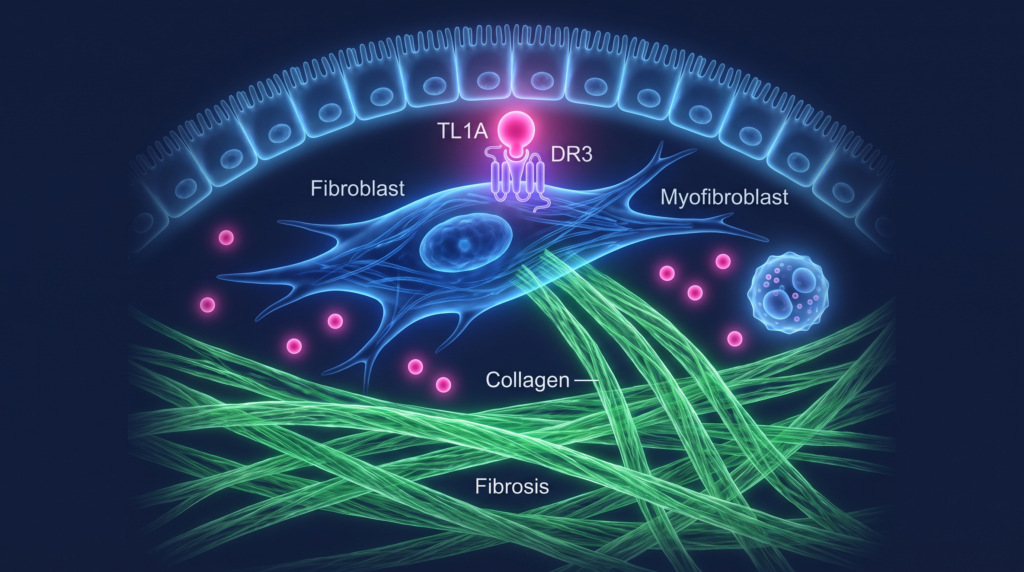
The expansion I find most interesting is into fibrosis. TL1A does not only inflame tissue. It signals directly to fibroblasts and drives the scarring that turns chronic inflammation into permanent damage. In IBD that shows up as the strictures that send Crohn’s patients to surgery. Outside the gut, the same immuno-fibrotic biology is being explored in settings like systemic sclerosis-associated interstitial lung disease. There, fibrosis, not inflammation, is what kills, and the current options do little. A single mechanism that reaches both the inflammatory and the fibrotic side of disease is not something we see often. So it is a large part of why the target is drawing attention across so many organs.
What TL1A beyond IBD still has to prove
I would temper the enthusiasm with some realism. Indication expansion is where a lot of promising mechanisms overreach. A target that works in the gut has its own particular immune wiring, plus a genetic link to IBD through TNFSF15. That does not automatically translate to the skin or the lung. Each of these indications is its own experiment, and most of the beyond-IBD data is still early. The breadth is a strong signal about the biology. It is not yet proof. So I would want to see the readouts before treating any of it as settled.
The pattern, and the trap
I have watched enough companies from the investor’s seat to know that indication expansion cuts both ways. Done well, it is how a single mechanism becomes a franchise. Done carelessly, it is how a good drug gets spread thin across trials it was never going to win. TL1A beyond IBD will be some of both. The programs worth watching are the ones where the underlying biology, immune costimulation and fibrosis, actually maps onto the disease. The ones to doubt are picked because the addressable market looked large on a slide. The genetics, the fibroblast signaling, the costimulatory logic travel to some tissues better than others. Sorting which is which is the whole game.
Why the gut stays central
Here I will be straight about our own vantage point. Altis models the gut, not the lung or the joint. So I am not going to pretend we sit at the center of every one of these indications. What I will say is this. The gut is where TL1A’s biology was first worked out. Both its inflammatory and its fibrotic arms are visible there. And the human tissue is the most tractable to model. If you want to understand a mechanism before chasing it across ten diseases, start in the intestine. It is a very good place to study it. That is the work we do on the RepliGut® platform. It is also why the gut will stay central to the TL1A story even as the target travels.
TL1A started as a gut story and is turning into an immunology story. If the mechanism holds up across even a few of these indications, it stops being the next IBD drug class. It becomes something larger. Either way, the case will be built one disease at a time. It will start where it always has, in the gut. That means human models of intestinal inflammation honest enough to show what the target really does, before the clinic finds out the hard way.