Most of the excitement in inflammatory bowel disease right now points upstream. The field spent two decades blocking finished cytokines, one at a time, and the newest programs are trying to reach the triggers instead: the microbial sensing, the barrier failure, the innate machinery that decides whether inflammation starts at all. TLR signaling in IBD sits at the center of that shift, which is why so many program leads are suddenly asking about it. The part that gets missed is where a lot of that sensing actually happens. It is not only the immune compartment. It is the gut lining itself.
The wave is real, and it is aimed upstream
Look at what has read out in the last two years. The anti-TL1A antibodies have moved from interesting to central. Merck’s tulisokibart met its primary endpoint in the Phase 3 ATLAS-UC induction study in ulcerative colitis, the first anti-TL1A biologic to show clinical remission at week 12 in a Phase 3 trial. Sanofi and Teva’s duvakitug, also anti-TL1A, posted positive Phase 2b results across ulcerative colitis and Crohn’s disease. Abivax reported positive Phase 3 induction data for obefazimod, an oral miR-124 enhancer that dials down inflammatory mediators rather than blocking a single cytokine, with a pooled placebo-adjusted clinical remission of 16.4 percent at week 8. Earlier in the pipeline, RIPK2 inhibitors are being pursued to quiet the NOD1/NOD2 arm of innate sensing, so far in preclinical and early clinical work.
None of those are TLR-pathway drugs in the strict sense. TL1A, NOD2, and miR-124 are innate and immune targets that sit near the TLR conversation, not inside it. So when a client says they are interested in TLR signaling, what they are usually circling is the whole upstream trigger layer: microbial recognition, barrier integrity, and the first wave of signaling that turns a normal gut into an inflamed one. TLR biology is the cleanest way into that layer. It is also the part of it that is most clearly epithelial.
The epithelium is an active TLR compartment, not a wall
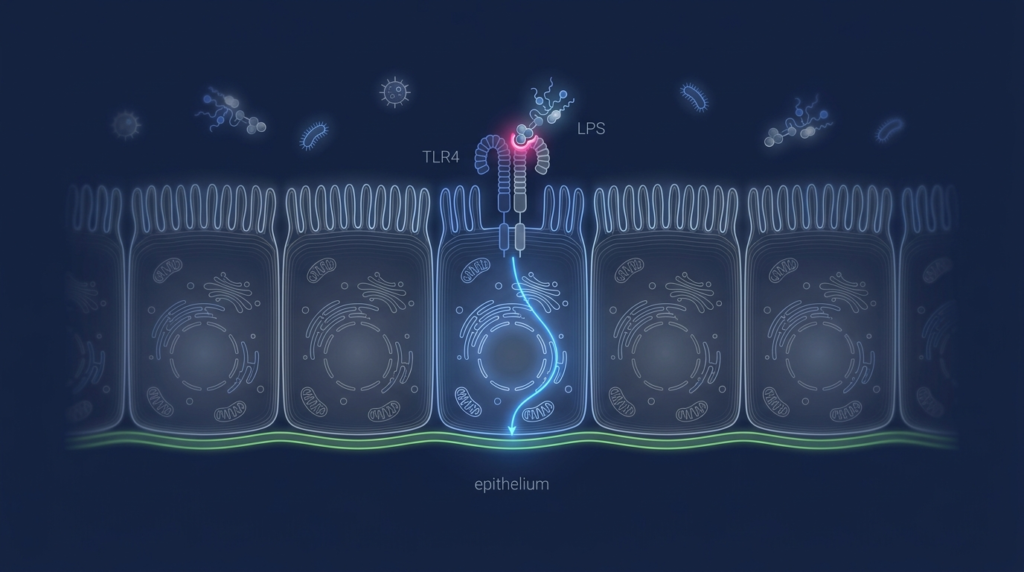
The mental model many people carry is that the gut lining is a passive barrier and the immune cells beneath it do the sensing. That is wrong, and the IBD data make it wrong in a specific, useful way. Intestinal epithelial cells express Toll-like receptors and signal through them. In IBD, that expression changes.
The clearest evidence is also some of the oldest. In a 2000 study of IBD mucosa by Cario and Podolsky in Infection and Immunity, TLR4 was abundantly expressed by the epithelial cells of every ulcerative colitis and Crohn’s patient examined, while it stayed minimal in healthy controls. TLR3, by contrast, was downregulated in Crohn’s. The authors proposed that this heightened epithelial TLR4 recognition of bacterial lipopolysaccharide could break the gut’s tolerance to its own commensal flora. The receptor tone of the lining itself, not just the immune cells behind it, helps set whether the tissue treats the microbiome as a neighbor or a threat.
That reframes the barrier problem. When the epithelium loses integrity, lipopolysaccharide and other microbial products cross more freely, and a lining already primed with elevated TLR4 meets that load with a stronger response. Barrier failure and innate activation are not two separate problems. They are coupled, and the coupling runs through the epithelial cell. TLR engagement drives NF-kB and MAP kinase signaling, which drives the cytokines everyone downstream is trying to block. If you want to understand where TNF, IL-6, IL-23, and TL1A get their start, a large share of the answer is happening in the cells that face the lumen.
This is the part I find interesting because it is measurable. Barrier integrity, epithelial TLR tone, and the cytokine output that follows are all things you can watch in the same tissue, if the tissue is right.
Why the model decides what TLR signaling tells you
That last condition is the catch. Epithelial TLR signaling is only as trustworthy as the epithelium you study it in, and the field’s two default models both distort it.
Caco-2 is a colorectal cancer line. It is transformed, and transformed cells carry rewired innate signaling, altered TLR expression, and a barrier that behaves like a fixed sheet rather than a living, renewing lining. You can run an experiment on it, but you are reading innate immunity off a cancer, which is not the biology a patient has. Animal models have the opposite problem. They are living tissue, but the wrong tissue: TLR ligand specificity, receptor expression, and microbial context differ enough between species that a mouse result frequently does not carry to a human gut. Both models can generate clean data. Neither one is reliably answering the human question.
How a human intestinal model interrogates this
This is the biology RepliGut® is built to reproduce. RepliGut uses primary human intestinal stem cells to grow a differentiated epithelium with the cell types, the barrier behavior, and the regional identity of real gut tissue, rather than the flattened signaling of a cancer line. That makes it a place where the questions above become experiments.
You can apply a defined TLR ligand or a lipopolysaccharide challenge to a human barrier and watch what the epithelium does. You can track barrier integrity and the inflammatory readout in the same tissue, which is what our InflammaScreen assay is designed to measure: how a human intestinal epithelium responds to an inflammatory insult, and whether a compound calms it. And because the model is regional and human, it lets you ask the coupled question directly. When the barrier is perturbed and microbial load rises, how much of the cytokine response is the epithelium’s own, and how much comes from what sits beneath it? For the immune-cell side of TLR biology, that is a co-culture question, and it is one a human epithelial model can be built toward rather than around.
None of this requires us to claim we have already run every one of those studies. The point is narrower and, I think, stronger: the trigger layer everyone is chasing is epithelial biology, and it deserves a human epithelial model.
| Model | Epithelial TLR fidelity | Barrier behavior | Human relevance |
|---|---|---|---|
| Caco-2 line | Transformed, rewired innate signaling | Static sheet, cancer-derived | Low for innate biology |
| Animal models | Species-specific TLR ligand response | Living but non-human | Limited by species differences |
| RepliGut® (primary human) | Primary human epithelial receptor tone | Renewing, region-specific barrier | Human by construction |
The takeaway for your pipeline
Your team is reading the field correctly. Interest in TLR signaling is a proxy for a bigger move: IBD drug development is working its way upstream toward the triggers, and the epithelium is where a large share of that triggering happens. The upstream wave, from TL1A to miR-124 to the NOD arm, is betting on that same logic. The question worth carrying into a program is simple. If innate sensing at the gut lining is where inflammation starts, are you studying it in a human lining or in a proxy that was never built to answer.
We think that is the more useful question, and it is the one our human in vitro IBD models are built to take on. If you want to see how this connects to the target everyone is watching, our explainer on TL1A in IBD covers the downstream side of the same story, and InflammaScreen shows how we read an inflammatory response in human intestinal tissue.
If TLR and barrier biology is live for your team, talk to us about what a human epithelial model can put in front of your program.