Here is a number that should stop any oral drug program cold. A compound absorbs at 63% in rats and 3% in humans. Same molecule, same route, a twenty-fold collapse the moment it crossed from the animal to the person. That is pomaglumetad, and species differences in drug absorption turned a preclinical success into a Phase I disappointment. The story is worth telling, because the failure was not bad luck. It was a model that did not reflect the human gut.
What the animal could not tell you
Pomaglumetad (LY404039) is an mGlu2/3 receptor agonist. In fasted rats it reached about 63% oral bioavailability with strong systemic exposure. On the strength of results like that, the molecule looked like a clean oral candidate. Then it went into humans, and oral bioavailability came back at roughly 3%. The drug was the same. The intestine was not.
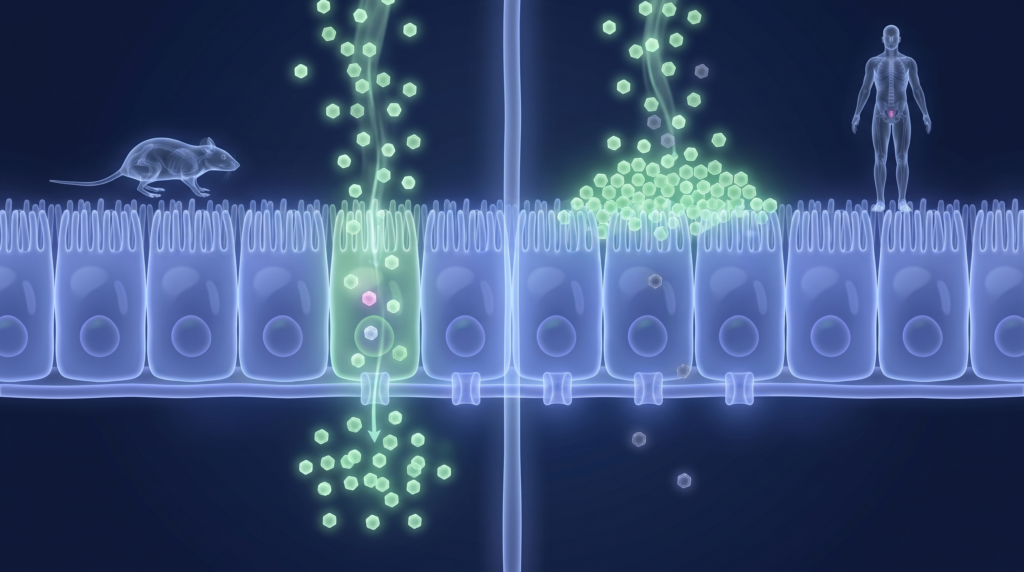
The cause was intestinal transport. The parent is a polar, amino-acid-like molecule that does not cross the epithelium well on its own, and the peptide transporter PEPT1 sits at the center of the story. PEPT1 biology, its expression and its transport behavior, differs between rodents and humans. So the absorption context that flattered the compound in a rat did not carry over to a person. The animal model was not lying. It was answering a question about rat physiology, and the answer did not transfer.
The problem is not just animals
It is tempting to file this under “animal models are imperfect” and move on. That misses the more useful point. Many in vitro systems share the same blind spot. Transporter expression and intestinal metabolism in a cancer-line monolayer often do not match human tissue, so the in vitro model can miss exactly the gap the animal missed. When neither your in vivo nor your in vitro model carries human intestinal transport, nothing in the preclinical package is positioned to catch a PEPT1-driven translation problem before the clinic does. The common failure is not the animal or the dish. It is the absence of human gut biology in the model.
| Oral bioavailability | What the model told the program | |
|---|---|---|
| Rat, parent (LY404039) | ~63% | Looked like a clean oral candidate |
| Human, parent | ~3% | The absorption seen in rats did not transfer |
| Human, prodrug (methionil) | ~49% (est.) | A PEPT1 substrate plus peptidase cleavage rescued exposure |
The prodrug fix, and what it needed
The program did not abandon the molecule. It re-engineered the absorption. Pomaglumetad methionil (LY2140023) adds a methionine to the parent, turning it into a substrate for the human peptide transporter. The prodrug is then carried across the intestine by PEPT1 and cleaved by peptidases to release the active drug once it is through. Human exposure improved substantially. That is prodrug design working as intended: use the gut’s own transport machinery to solve an absorption problem the parent could not.
But notice what the fix depends on. To design a prodrug around PEPT1, you have to be able to watch PEPT1 do its job in human tissue. A model that does not express the human transporter cannot tell you whether your prodrug engages it, how quickly, or whether the downstream cleavage happens where you want it. The rescue and the diagnosis need the same thing: a system that carries human intestinal transport.
Why species differences in drug absorption keep winning
This is the throughline of every hard oral-absorption story. Rat to human, in vitro to in vivo, parent to prodrug: the predictions break exactly where the model stops reflecting the human intestine, its transporters, its enzymes, its barriers. Get those wrong and a molecule can look finished when it is not, or look dead when a prodrug would have saved it.
That is the biology RepliGut® Planar is built on. Because it is grown from primary human intestinal stem cells, it expresses human uptake and efflux transporters, PEPT1 among them, along with the intestinal metabolism that shapes first-pass exposure. So a program can ask the human question early: does this compound actually cross human tissue, and if not, does a prodrug strategy fix it? That is the same question pomaglumetad answered the expensive way, in the clinic. The carboxylesterase version of this problem is a close cousin, and it points to the same conclusion.
Species differences in drug absorption are not a footnote to translation. Often they are the whole story. The way to stay ahead of them is to ask the human question on human tissue, before the clinic asks it for you, and to build the prodrug bioavailability picture on a model that reflects the gut a patient actually has. That is the work worth doing early, on human intestinal tissue, while it is still cheap to change your mind.